

Yes, men deal with PMS… well they deal with people they love who have PMS rather. And that can be stressful. So these are some of my top tips for how to handle your partner when they’re going through PMS.
Quick answer:
If your partner is experiencing PMS, the most effective way to handle it is to stay calm, avoid taking mood changes personally, and offer specific support based on what she needs that day. Give her space if she needs it.
The goal isn’t to “fix” anything. You need to create stability, lower stress, and communicate clearly.
Set healthy boundaries with your partner, but knowing when that time of the month rolls around can help you stay prepared for mood fluctuations.
Check out our PMS Cycle Calculator as well.
What is PMS Actually
Premenstrual Syndrome (PMS) is a group of physical and emotional symptoms that occur in the days leading up to a menstrual period. Hormonal shifts, especially in estrogen and progesterone, influence mood regulation, energy, sleep, and stress sensitivity.
Common symptoms include:
- Irritability or shorter patience
- Mood swings
- Fatigue
- Anxiety or low mood
- Physical discomfort like cramps or headaches
From your perspective, it can feel like a sudden shift in how your partner reacts to things. Small issues can escalate faster. Neutral comments may land wrong.
This is because her nervous system is under more strain during that phase of her cycle, it’s never personal.
The Real Mistake
Don’t try to argue logically with an emotional state.
When your girlfriend or wife is experiencing PMS-related irritability, logic alone rarely helps. It can even make things worse because it feels dismissive.
Another common mistake is overcorrecting. Some guys become overly cautious, walking on eggshells, which creates tension of a different kind.
The better approach sits in the middle: grounded, calm, and responsive.
What Actually Helps
1. Lower the “background stress” in her environment
Small actions have a larger effect during PMS.
You don’t need a grand gesture. You need to remove friction:
- Handle a chore without being asked
- Keep plans simple
- Avoid adding last-minute obligations
- Be on time and predictable
This reduces the load her body and mind are already struggling with.
2. Don’t take emotional spikes personally
If your girlfriend or wife is in PMS she will likely have a shorter fuse.
Pause before reacting.
This keeps things from escalating.
There are real mental, emotional, and hormonal changes happening here. The partner you love so much is in a fog and likely not feeling their best. Try to give her some space and grace during this.
3. Reduce her mental load
During PMS, her brain isn’t operating at 100%. This is where you as the man actually taking the lead will be highly appreciated.
Bad:
“What do you want to do?”
Better:
“Do you want quiet time or should we watch something together?”
You’re reducing effort on her part.
4. Get familiar with her cycle
Patterns repeat. Once you recognize them, you can anticipate instead of react.
Some couples track cycles using apps. Others just notice patterns over time.
Knowing when PMS usually hits helps you:
- Avoid scheduling stressful conversations
- Plan lower-key activities
- Show up more intentionally
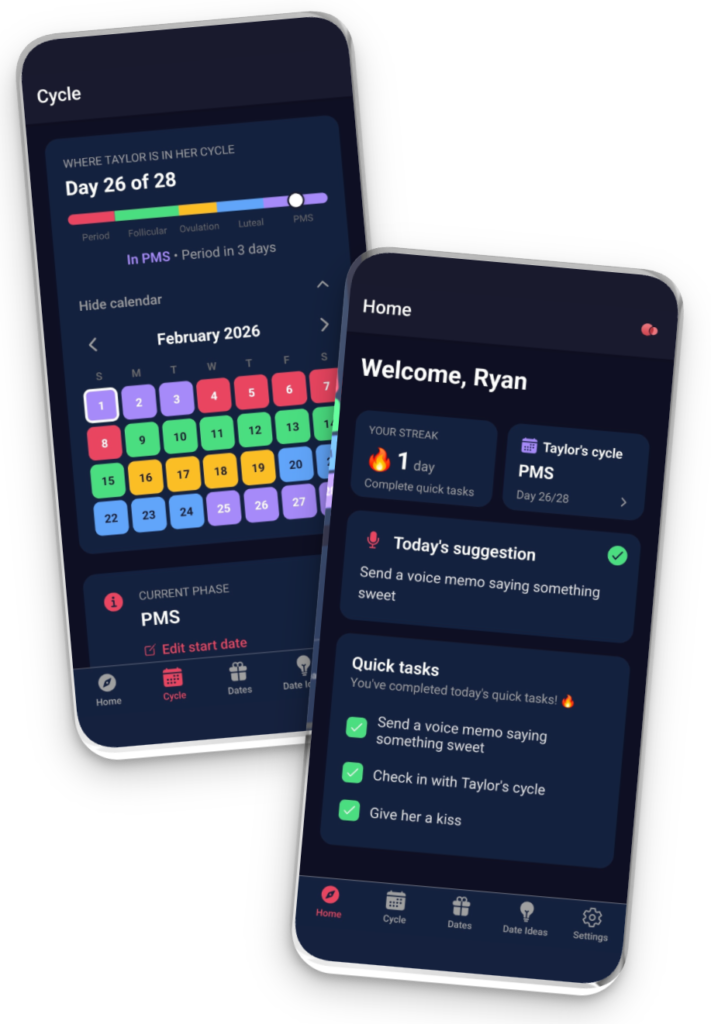
One simple way to do this without guesswork is using a cycle tracking app like DuoSync. The special thing about this particular app however is that it’s made specifically for you as the man to use. No need for your partner to input her data.
You can download the DuoSync app below:


What to Avoid During PMS
- Don’t say “it’s just PMS.” Even if it’s true, it feels invalidating
- Don’t escalate tone even if hers rises first
- Don’t withdraw completely unless she clearly wants space
- Don’t try to win arguments during this window
Think of it as a temporary sensitivity period. Your role is to stabilize, not dominate.
| Situation | What Helps | What Backfires |
|---|---|---|
| She’s irritable | Stay calm, keep responses short and neutral | Matching intensity or sarcasm |
| She’s overwhelmed | Take something off her plate | Asking her to organize everything |
| She’s emotional | Listen without fixing | Offering solutions too quickly |
| She’s distant | Give space but check in lightly | Ignoring her completely |
Example
You come home after work. She seems tense. You ask a simple question and she snaps.
Bad reaction:
You defend yourself, point out she’s being unfair, and the situation spirals.
Better reaction:
You pause, lower your tone, and say:
“Got it. Seems like a rough day. I’ll give you a bit of space. I’m here if you want to talk.”
Then for the cherry on top give her a quick kiss and be off to do whatever it is you need to do.
You didn’t escalate. You didn’t snap back. You stayed steady.
That’s the idea here.
How to Communicate About PMS
The best time to improve this dynamic is outside the PMS window.
Pick a calm moment and ask:
- “What actually helps you during that time?”
- “Do you prefer space or more support?”
- “Anything I do that annoys you more during that week?”
It also shows you’re paying attention, which builds trust with your woman.
When PMS Is More Severe
Some women experience stronger symptoms, sometimes diagnosed as PMDD (Premenstrual Dysphoric Disorder).
Signs it may be more than typical PMS:
- Intense mood swings that disrupt daily life
- Severe anxiety or depression
- Frequent relationship conflict tied to cycle timing
In those cases, support still matters, but professional help may also be needed. Encouraging that conversation should be done gently, not during conflict.
The Mindset Shift That Changes Everything
You’re not dealing with a “problem to solve.”
You’re dealing with a temporary shift in emotional bandwidth.
When you stop trying to correct and start trying to stabilize, everything improves.
Consistency beats perfection here.
The real key here is simply being observant. Which is why you should be tracking her cycle if your partner has pretty bad PMS.
PMS FAQs For Guys
How long does PMS usually last?
Typically 3 to 7 days before a period starts, though it varies by person.
Should I bring up PMS during an argument?
No. It often feels dismissive in the moment. Talk about patterns later when things are calm.
Is it okay to give her space?
Yes, if that’s what she prefers. The key is not disappearing. Stay available without hovering.
What if I feel like I’m always walking on eggshells?
That’s a sign you need a conversation outside the PMS window.
Can lifestyle changes help reduce PMS symptoms?
Yes. Sleep, nutrition, stress management, and exercise all play a role. You can support these indirectly by creating a less stressful environment.
Final Takeaway
Handling PMS well isn’t about memorizing the right lines. It’s about emotional control, awareness, and reducing unnecessary friction.
If you stay steady, pay attention to patterns, and respond instead of react, your relationship won’t just survive PMS. It’ll get stronger because of how you handle it.