My fiance has PMDD and it can really catch me off guard. Sometimes I think “what is happening right now??” then remember it’s probably PMS. The problem is I was never really know for sure until after the fact.
We agreed that tracking her cycle could help me understand her better and be more prepared.
If you’re reading this, you’re already ahead. And let me tell you it helps. It really helps to know what to expect on what days. It makes for a whole lot less drama and a whole lot more love.
Why Should You Track Your Partner’s Cycle?
Let me make this clear from the start… tracking your partner’s cycle is not about control, it’s about understanding her biological reality.
Here’s what tracking actually does for you…
You’ll stop stepping on landmines. That argument that came out of nowhere? It might have been preventable if you’d known she was dealing with PMS. Understanding her cycle helps you pick your battles and give her extra grace during the harder days.
You’ll plan better. Want to book that camping trip or plan a vacation? Checking her cycle is kind of important! She’ll appreciate not having to be the one who brings it up.
You’ll understand mood changes. When you know her cycle, you stop taking things personally. That irritability isn’t about you, her hormones are literally making her feel different. This knowledge helps you respond more sensitively.
Understanding the Menstrual Cycle: What You Actually Need to Know
Before you can track your partner’s cycle, you need to understand what’s actually happening.
The Four Phases Explained
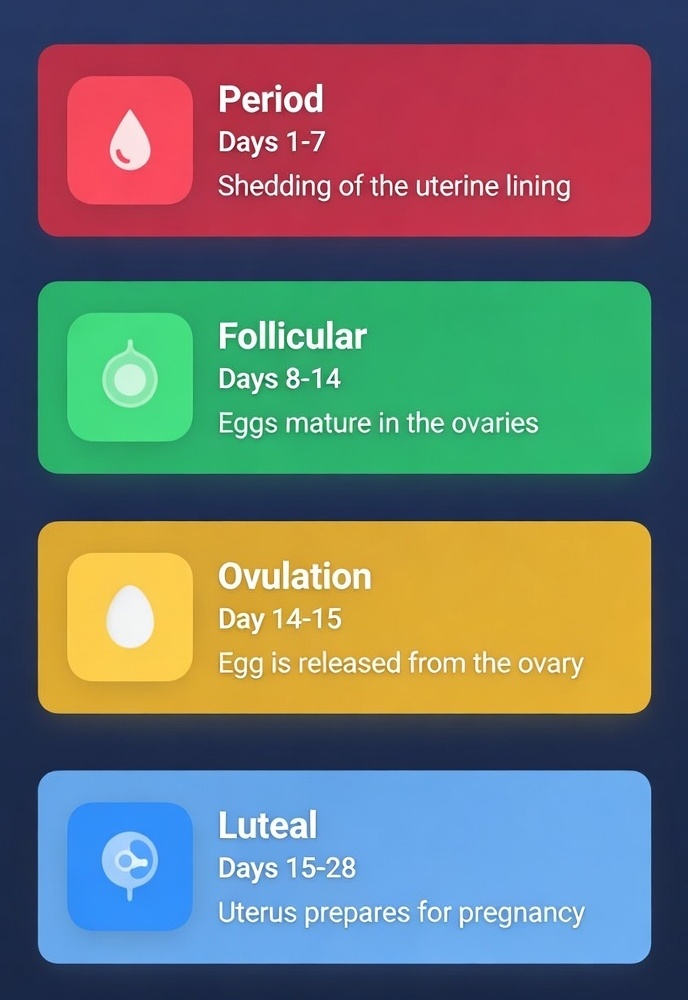
Menstruation (Days 1-5): This is her period, the bleeding phase. Day 1 is the first day of bleeding. She might experience cramps, fatigue, lower back pain, and bloating. Energy levels are usually low.
Follicular Phase (Days 6-13): Right after her period, her body starts preparing to release an egg. Estrogen levels rise, which usually means she’ll feel more energetic, social, and positive. This is often when she’ll feel most like herself or even better. It’s a great time for date nights and new activities.
Ovulation (Around Day 14): Her body releases an egg. Estrogen peaks, and many women feel their best during this 1-3 day window. She will have peak energy, feel more confident, and yes, often has a higher sex drive. If you’re trying to conceive, this is your window. If you’re trying not to, be extra careful.
This is a great time to suggest or initiate intimate activities. Use that information as you will.
Luteal Phase (Days 15-28): After ovulation, progesterone rises while estrogen drops. This is when PMS happens for many women. In the last week especially, she might experience mood swings, irritability, anxiety, breast tenderness, food cravings, and fatigue. These symptoms are real and hormonal.
Cycle Length Varies
The textbook says 28 days, but reality is a bit messier. Normal cycles range from 21 to 35 days. Your partner’s might be 26 days one month and 30 the next.
Stress, travel, illness, and weight changes can all shift timing. Some women are clockwork-regular; others are all over the map. Both are normal.
A quick check on Reddit confirms this reality for the women of the world. Some say 25 days, others 36 days. Try to figure out her baseline length for best accuracy.
How to Actually Track Your Partner’s Cycle
Now for the practical part. You have several options for tracking, each with pros and cons:
Method 1: Use a Period Tracking App
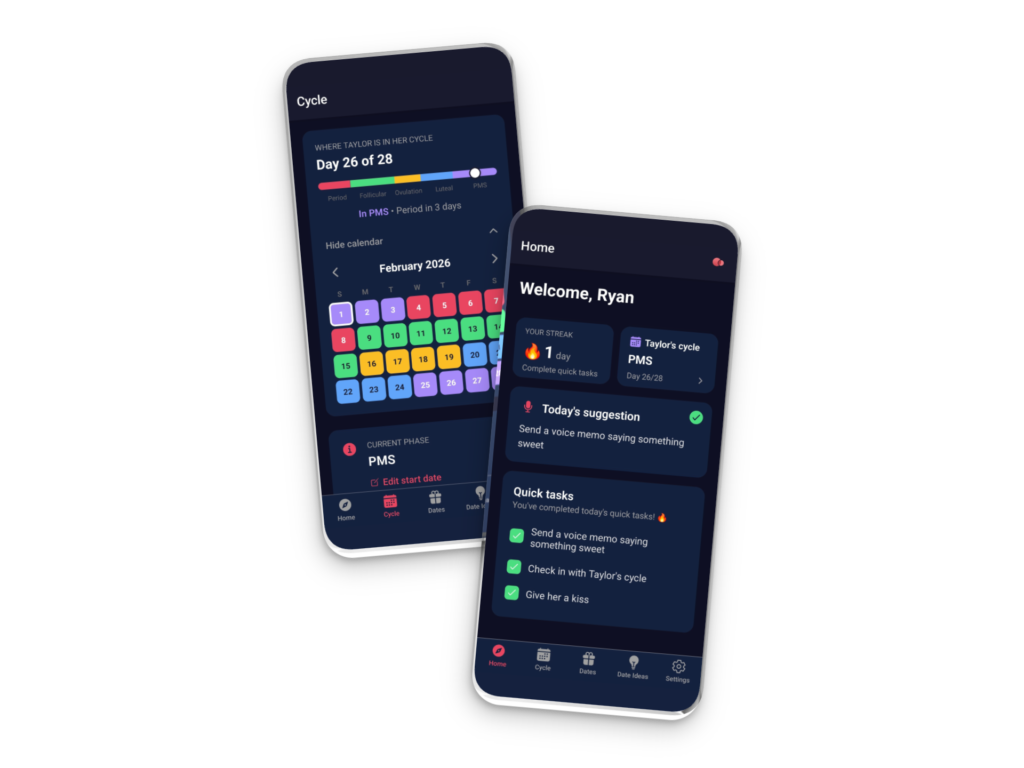
There exists an app designed specifically for men to track their partner’s cycle – DuoSync. That’s the app I made and it’s what I personally use to stay in sync with my fiance’s period.
It’s built for men who want to be supportive partners, not for the person experiencing the cycle.
The interface shows you everything you need to know: when her period is coming, what phase she’s in, and what symptoms she might be experiencing.
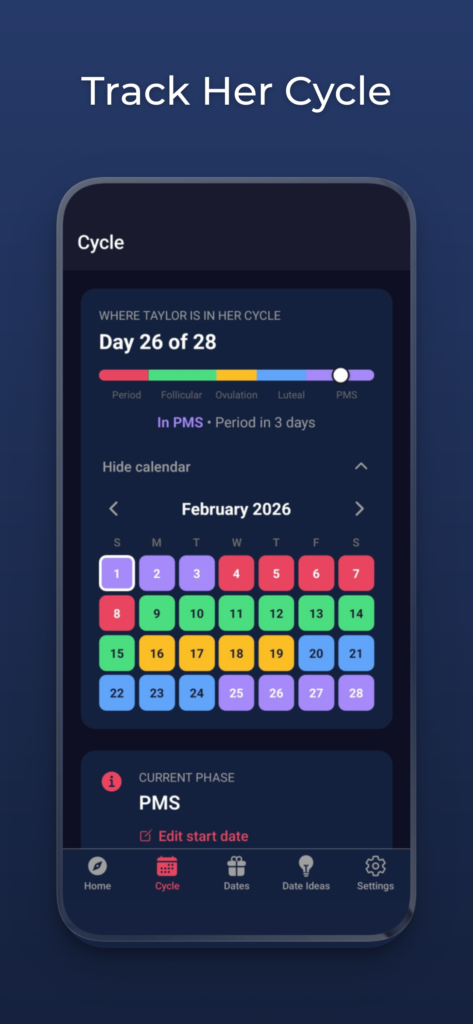
You get notifications ahead of time. A few days’ warning that her period is coming or that PMS symptoms might be starting.
Your partner doesn’t have to share her personal tracking data. You simply ask her when her last period started and you get simplified cycle tracking. She maintains her privacy while you stay informed.
The app let’s you adjust her cycle length and start date anytime if things shift.
You can download the app on iOS or android app stores by searching for “DuoSync”.
Method 2: Track on a Shared Calendar
If apps aren’t your thing, a simple shared calendar works. Create recurring events for her typical cycle length (start with her average). Mark period days, estimated ovulation, and when PMS might start.
Pros: Simple, no new app needed, easy to adjust.
Cons: Requires manual updates, won’t account for irregular cycles well, no symptom tracking or predictions.
Method 3: Ask Her to Share from Her App
Many period tracking apps women use (like Flo or Clue) have partner-sharing features. She can give you limited access to see cycle predictions.
Pros: She’s already tracking, so data is accurate and up-to-date.
Cons: Many apps don’t have great partner interfaces, you might see more personal info than either of you want shared, and you’re dependent on her updating it.
What Information Should You Track?
Here’s what you should know for tracking.
Essential: First day of period (Day 1) and average cycle length.
Helpful: common symptoms she experiences, estimated ovulation window.
How to Talk to Your Partner About Tracking
The conversation can feel awkward, but it’s important to get your partner’s consent.
The Right Approach
Be direct and genuine about it.
Emphasize it’s about support, not control. Make it clear you want to be proactive, not use this information against her.
If you’ve ever made her feel bad about PMS symptoms before, acknowledge that and say you want to do better.
Let her set the boundaries.
What Not to Say
Don’t make it sound clinical: “I want to monitor your cycle” sounds creepy. “I want to support you better” is caring.
Don’t bring it up mid-argument: “Maybe you’re just on your period” is the fastest way to make this whole thing backfire. Never use cycle information as a weapon in a fight.
How to Use This Information
Having the information is one thing. Using it well is another. Here’s what I would do with the info from each cycle.
During Her Period
Practical support: Make sure supplies are stocked before Day 1. Have pain relievers available. Offer to grab a heating pad or run a hot bath. Do the dishes without being asked.
Food: Keep her favorite comfort foods on hand. Many women crave chocolate, salty snacks, or specific meals. Stock up ahead of time.
Plans: Suggest low-key activities. Netflix and couch time beats an intense hike. If she wants to go out, great—but give her easy outs.
Intimacy: Ask, don’t assume. Some women want sex during their period; others absolutely don’t. Be flexible with physical intimacy overall. Extra cuddles might matter more than anything else.
During PMS Week
This is where tracking really pays off. PMS hits hard for most women, and knowing it’s coming helps you both:
Pick your battles: That thing you’ve been meaning to bring up? Maybe wait a week. Serious conversations about money, relationships, or future plans go better when she’s not also dealing with mood swings.
Extra patience: If she snaps at you, take a breath before responding. Hormones don’t excuse bad behavior, but they do explain it. Try to respond to the emotion, not the words as difficult that may be in the moment.
Proactive help: Take things off her plate. Handle dinner, tidy up, deal with the task she’s been dreading.
Validation: “I know this week is tough for you” goes a long way. Don’t dismiss her feelings as “just hormones.”
During Ovulation and Follicular Phase
These are often her best weeks. She’ll likely have more energy, feel more social, and be in a better mood overall.
This is when to: Plan date nights, have important conversations, tackle projects together, try new activities, and be spontaneous.
If you’re trying to conceive or trying not to, this is also when you need to be most careful about contraception. Ovulation is the only time pregnancy can happen.
Common Mistakes to Avoid
Even with good intentions, you can make things harder on yourself. Don’t do these few things and you should be fine:
- Don’t announce what phase she’s in.
- Don’t blame everything on her cycle.
- Don’t track without permission.
- Don’t over do it.
Yeah that’s about it for what to avoid. Other than that as long as you’re respectful with your tracking it can be real game changer in your relationship.
Getting Started: Your First Month
The first few months are about learning her patterns. Here’s how to approach it:
1. Just Track
Start simple. Ask when her period starts and log it. Note when it ends. That’s it. You’re just establishing a baseline.
2. Watch for Patterns
Once you start tracking pay attention to her symptoms and moods. When does PMS seem to start? What symptoms come up? How long does her period typically last? Don’t tell her what you’re noticing yet. Just observe and learn.
Other things to note
If She Has PCOS, Endometriosis, or Other Conditions
Many women have conditions that affect their cycles. PCOS can make cycles irregular or absent. Endometriosis can make periods extremely painful. PMDD makes PMS symptoms severe enough to be disabling.
If your partner has been diagnosed with any reproductive health condition, listen to what she tells you about it. Her experience might not match the standard four-phase cycle. Track what’s real for her, not what’s typical.
When to Stop Tracking
If she asks you to stop, stop. Maybe she found it helpful at first but now feels monitored. Maybe her cycle changed and tracking isn’t useful anymore. Maybe she just doesn’t want you to have this information.
Also stop if you find yourself using the information in ways that feel controlling or dismissive.
The whole point is to be more supportive. If tracking is making things worse instead of better, it’s time to stop.
The Bottom Line
Tracking your partner’s menstrual cycle isn’t complicated, but it does require intention and respect.
Start simple: track when her period starts, pay attention to patterns, and use that information to be proactive. Stock supplies before she asks. Plan thoughtfully around her cycle. Give her extra grace during PMS.
Most importantly, remember that she’s still a whole person whose thoughts, feelings, and experiences extend far beyond her hormones.
Done right, cycle tracking is just one more way to show that you’re paying attention, that you care about her comfort, and that you’re willing to put in the effort to be a truly supportive partner. That’s what good relationships are built on.
If you’re looking for an easy way to get started, DuoSync is an app designed specifically for partners who want to track and support without overstepping. It gives you the information you need while respecting her privacy—exactly what tracking should do.