
To understand female hormones as a man, you need to view the month as a four phase cycle rather than just the few days of the period itself.
You are looking at a repeating rise and fall of estrogen and progesterone that dictates energy, mood, and physical comfort for about twenty eight days at a time.
I used to think my girlfriend just had a rough few days every month, but once I actually looked at the data, I realized her entire personality and physical capability were shifting based on where she was in her cycle. It is not just about being moody. It is a biological chemical shift that affects everything from how well she sleeps to how much social interaction she can handle.
The biggest thing I learned is that estrogen is basically the energy and confidence hormone. When it rises in the first half of the cycle, she is usually more upbeat and adventurous. When it drops off after ovulation, progesterone takes over. That is often when the brain fog and fatigue hit. If you can track these shifts, you stop taking things personally. When she is suddenly exhausted or wants to stay in on a Friday night, it is usually just her luteal phase talking.
Here is a quick breakdown of how the phases usually look for me and my partner:
Follicular Phase (Days 7 to 14): This starts when the period begins. Estrogen starts low but climbs. Usually, by day five or six, she starts feeling like herself again. This is the best time for dates or trying new things.
Ovulation (Around Day 14): Estrogen peaks. She might have the most energy here. It is a short window, maybe twenty four to forty eight hours, where everything is dialed up to ten.
Luteal Phase (Days 15 to 28): This is the part guys usually struggle with. Progesterone rises. This hormone is meant to calm the body down, but it often causes bloating, acne, and irritability. About a week before the period starts, estrogen crashes. That is the PMDD or PMS zone. She might feel more sensitive or anxious.
Menstrual Phase (Days 1 to 7): The actual period. Progesterone and estrogen both bottom out. The body is physically working hard to shed the uterine lining. This is the time for the heating pads and the snacks.
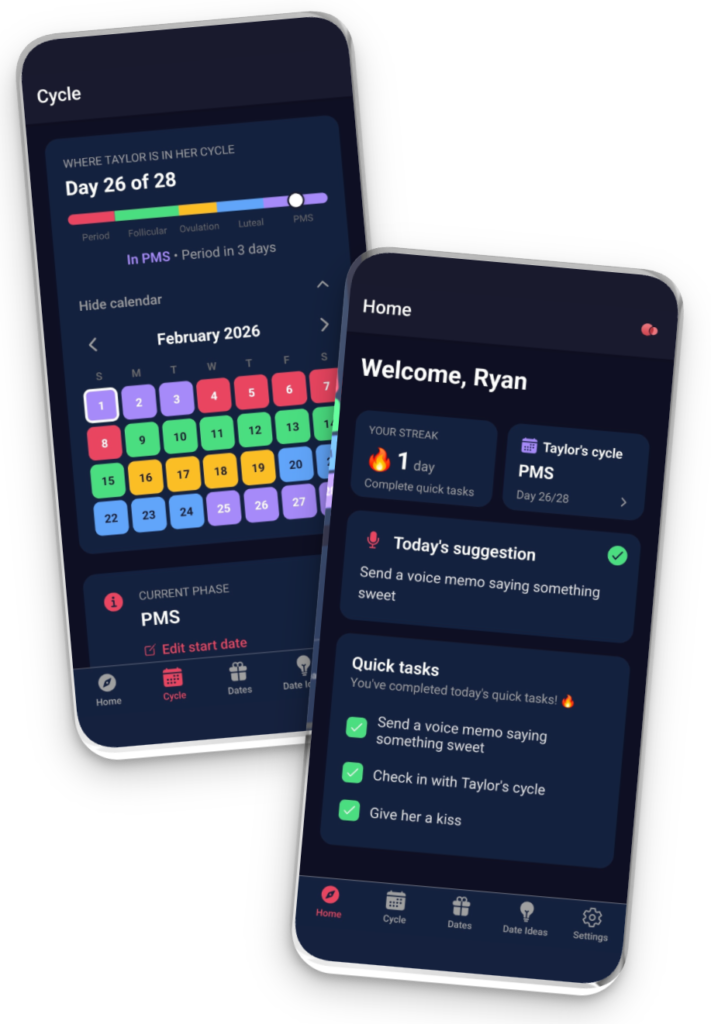
I honestly started using an app called DuoSync to keep track of where she is. It is a period tracker designed for men, so I get a heads up when she is entering that low energy phase. It saves a lot of arguments.


Download the DuoSync app to grow closer to your partner.
You also have to realize that every woman is different. Some women have massive spikes in cortisol (the stress hormone) during their cycle, which makes them feel like they are under constant pressure. If she seems “on edge” for no reason, check the calendar. It is probably just a chemical signal telling her body to be on high alert.
Practical stuff that actually helps:
Pick up the slack on chores during the last week of the cycle. Her physical energy is literally lower then. Don’t ask “is it that time of the month” even if you know it is. Just provide the comfort. Keep a stash of ibuprofen and a good heating pad. Understand that her brain chemistry is changing. It is not a choice or a lack of discipline.
Frequently Asked Questions
How do hormones affect mood?
When estrogen drops rapidly before a period, it can cause a dip in serotonin. This leads to the classic feelings of sadness or irritability that people call PMS.
Can men track a partner’s period?
Yes, using a shared calendar or an app like DuoSync is a great way to stay informed without having to ask her for updates constantly.
What is the luteal phase?
This is the time between ovulation and the start of the period. It is usually when symptoms like bloating, fatigue, and mood swings are most prominent due to high progesterone.
How long does a hormone cycle last?
While twenty eight days is the average, a healthy cycle can range from twenty one to thirty five days. Consistency is usually more important than the specific number of days.