

Before I start, I want to share with you that I’ve experienced a relationship with someone who has PMDD. And it’s hard. I know.
One week things are great, you’re getting along, the intimacy is great. The next you’re living in emotional hell and everything you do is wrong.
You’re really not alone though. Many men are in relationships with women who suffer from PMDD and there are some really helpful things you can do that will make life easier during that time of the month.
Spoiler: The #1 thing you need to be doing is tracking her cycle.
What PMDD Actually Feels Like
Premenstrual Dysphoric Disorder is not typical PMS. It’s a severe, hormone-related mood disorder tied to the menstrual cycle.
Most partners misunderstand it at first. It can look like:
- Sudden emotional distance or irritability
- Intense anxiety or sadness out of nowhere
- Arguments that seem out of proportion
From your side, it can feel confusing or even personal. From her side, it can feel like losing control of her own mind for several days every month.
But remember… this is cyclical, not random, and not about you.
The PMDD Timeline (Know When It Hits)
PMDD symptoms usually show up during the luteal phase, after ovulation and before the period.
| Phase | What Happens | What You’ll Notice |
|---|---|---|
| Follicular (after period) | Hormones stable | She feels like herself |
| Ovulation | Estrogen peaks | Energy, connection often high |
| Luteal (PMDD window) | Hormone sensitivity triggers symptoms | Mood swings, irritability, withdrawal |
| Period starts | Hormones drop | Symptoms often ease quickly |
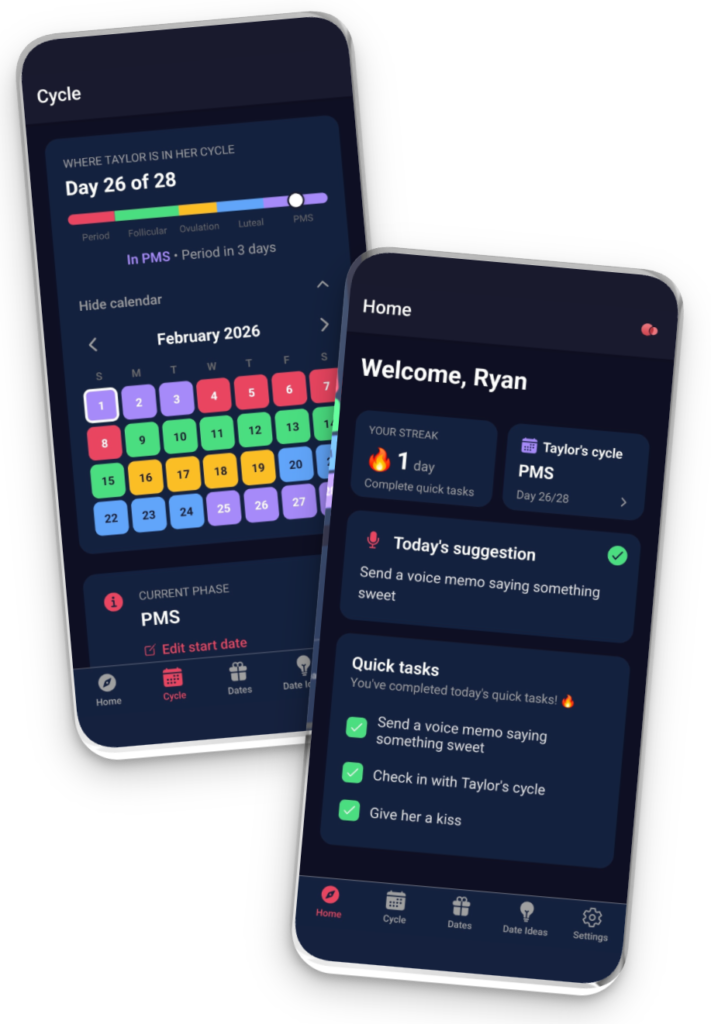
Once you see the pattern, everything starts to make more sense. Without that awareness, it just feels chaotic. This is why you need to be tracking her cycle with an app like DuoSync, which is specifically designed for men to track their partner’s cycle.
You can download the DuoSync app below:


What To Do When Symptoms Hit
This is where most guys either help make things easier or make it worse.
1. Stop Trying to Logic Your Way Through It
During PMDD, emotional regulation is impaired. Rational arguments won’t land.
If she says something harsh, your instinct might be to correct it or defend yourself. That usually escalates things.
What works better:
- Keep your responses short
- Don’t debate feelings
- Focus on calm presence over winning the point
Be a rock for her. That means staying steady… not being taken off center if she snaps at you.
2. Lower the Pressure on the Relationship
This is not the time to:
- Solve long-standing issues
- Push for deep conversations
- Demand clarity about the relationship
Save those for the stable part of her cycle. Timing matters more than wording.
3. Discuss PMDD With Her Outside The Luteal Phase
The best couples plan ahead.
During a good week, ask:
“What helps you most during the hard days?”
Common answers:
- More space
- Extra reassurance
- Fewer responsibilities
- Quiet time instead of social plans
Write it down. Treat it like a playbook.
What Not To Do (These Will Backfire)
You don’t need a long list. Just avoid these:
- Taking everything personally
- Saying “just calm down” or “it’s not that big a deal”
- Bringing up past arguments during a PMDD episode
- Trying to “fix” her emotions
Those responses usually come from frustration. Understandable, but not helpful.
The key here is realizing she’s in PMDD. If you’re oblivious to her phase, then you won’t understand why she is acting the way she’s acting.
How To Talk About PMDD Without Causing a Fight
Timing is everything here.
Bring it up when she feels normal again. Not during an episode.
Keep it simple:
“I’ve noticed certain times of the month feel really hard for both of us. I want to understand how to support you better.”
That framing matters.
Treatment Options She Might Be Exploring
You’re not her doctor, but it helps to understand what’s out there.
Common treatments include:
- SSRIs like Fluoxetine or Sertraline
- Hormonal birth control
- Lifestyle changes (sleep, diet, exercise)
- Therapy, especially cognitive behavioral approaches
Some women respond quickly to SSRIs, even if taken only during the luteal phase. Others need trial and error.
Your role is support.
How To Protect Your Own Mental Health
This part gets ignored, but it matters.
Supporting someone with PMDD can be draining if you don’t set boundaries.
You’re allowed to:
- Step away from escalating arguments
- Take space when things get intense
- Say “I care about you, but I need a break right now”
Support doesn’t mean absorbing everything.
There’s a whole subreddit r/PMDDpartners dedicated to partners of people with PMDD. Check in with that community for support and answers.
A Simple Monthly System
Here’s what worked in my own relationship:
Step 1: Track the cycle
Use a shared calendar or app or track her cycle with a dedicated partner tracking app for men like the DuoSync app.
Step 2: Label the PMDD window
Mark 5–10 days before her period as “low-pressure days”
Step 3: Adjust expectations
- Fewer plans
- More flexibility
- Less emotional intensity
Step 4: Debrief after
Talk about what worked and what didn’t once symptoms pass
It doesn’t have to be perfect. It just needs to be intentional.
When It’s More Than You Can Handle
Sometimes PMDD creates serious strain.
Watch for:
- Persistent thoughts of self-harm
- Severe depression
- Relationship breakdown every cycle
If that’s happening, encourage professional help. A gynecologist or psychiatrist familiar with PMDD can make a big difference.
It’s up to you and your partner to decide what’s ultimately best for your relationship. I’ve seen relationships break down over this, but it doesn’t have to.
FAQ
Is PMDD an excuse for bad behavior?
No. It’s a real medical condition. At the same time, both partners are still responsible for how they handle conflict. Understanding it helps reduce harm, but it doesn’t mean anything goes.
Can PMDD ruin a relationship?
Yes it can. But ultimately if you have a truly loving and good partner, it shouldn’t ruin the relationship. It can strain it, especially if neither person understands what’s happening. Couples who learn the pattern and adapt usually do much better.
Should I bring it up if she hasn’t mentioned PMDD?
Yes, but gently and at the right time (not during an episode).
Do symptoms go away completely after the period starts?
Often they drop off quickly, sometimes within a day or two. That sudden shift can feel confusing if you’re not expecting it.
How do I know if it’s PMDD or just stress?
PMDD follows a consistent monthly pattern tied to the menstrual cycle. Stress doesn’t follow that same rhythm.
The Bottom Line
You don’t need to become an expert in hormones. You need to become predictable, calm, and aware though.
If you can recognize the pattern, avoid escalating during the hard days, and support her in a way she actually finds helpful, you’ll already be doing more than most.
And that’s usually what makes the difference.