
Your girlfriend is likely more affectionate because her body is experiencing a massive surge in estrogen and luteinizing hormone. These hormonal shifts naturally increase libido and social motivation as the body prepares for potential reproduction.
I’ve been tracking these patterns for a while now, and it’s honestly fascinating how much biology plays a role in daily behavior. When a woman is ovulating, she’s at the peak of her fertility for the month. Evolutionarily speaking, it makes sense that she’d feel more “lovey-dovey” or physically clingy.
Research actually shows that during this window, women often experience a boost in mood and energy. Estrogen is a bit of a feel-good hormone, and when it spikes right before the egg is released, it can make her feel more confident and outgoing.
It isn’t just about sex drive, though that is a big part of it. You might notice she wants to cuddle more, holds your hand longer, or is just generally more “present” in the relationship. Some guys describe it as a “honeymoon phase” that repeats every 28 days or so.
I’ve noticed with my own partner that her skin even looks clearer and she seems to have more “glow” during this week. It’s a real physiological shift.
Another interesting factor is the rise in testosterone. While we usually think of that as a male hormone, women have it too. It peaks during ovulation, which contributes to that extra “spark” in her personality and her desire for physical closeness.
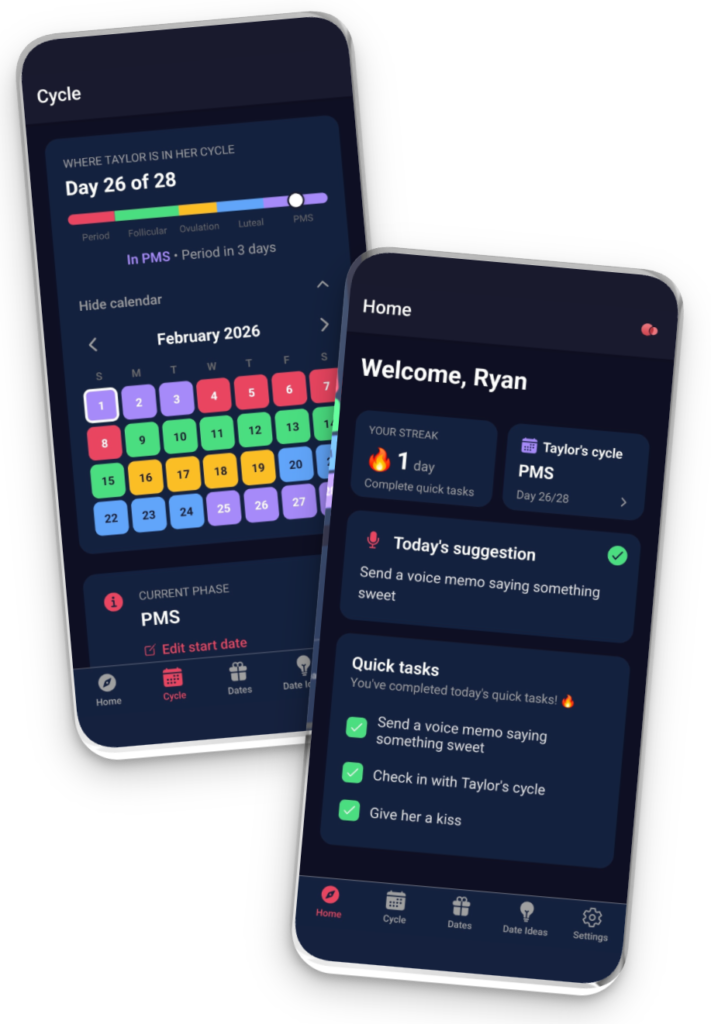
If you want to get ahead of the curve and understand when these shifts are coming, it helps to keep track of the calendar. I personally use an app called DuoSync. It’s a period tracker specifically designed for men so you can see where she is in her cycle. Knowing when she’s ovulating helps me realize, “Oh, that’s why she’s being extra sweet today,” and it also helps me prepare for the moodier luteal phase that usually follows.


Download the DuoSync app to grow closer to your partner.
On the flip side, some women might not even realize they are doing it. It’s a subconscious drive. If you find it a bit overwhelming or if it’s a sudden change from her usual self, just lean into it. It’s a great time to plan dates or spend quality time together because her social battery is usually at its highest.
FAQ
Does every woman get more affectionate during ovulation?
Not necessarily. While the hormonal surge is standard, every woman reacts differently. Some might feel more energetic and want to go to the gym or socialize with friends rather than focus specifically on a partner. Factors like birth control can also dampen these natural hormonal peaks.
How long does the “ovulation glow” and affection last?
The most intense window is usually about 24 to 48 hours, but the “high estrogen” phase can last for 5 to 7 days. Once ovulation passes and progesterone starts to rise, you might see that extra affection taper off as she moves toward her period.
Why does she suddenly stop being affectionate after a week?
That is usually the transition into the luteal phase. Progesterone takes over, which can lead to PMS, bloating, and fatigue. It’s not that she loves you less, her body is just shifting gears from “high energy/fertility” to “rest and reset.”
Can tracking her cycle help our relationship?
Absolutely. Using a tool like DuoSync lets you anticipate these changes. If you know she’s about to be in that affectionate, high-energy phase, you can plan something special. Likewise, you’ll know when to bring her snacks and give her space when the cycle shifts later on.