
Men who understand and track their partner’s menstrual cycle report fewer relationship conflicts, better communication, and a stronger emotional connection. Cycle awareness helps you show up at the right moments, plan more effectively as a couple, and avoid misreading emotional signals.
So you want to track her cycle…
Tracking your partner’s menstrual cycle means knowing roughly where your partner is in their cycle at any given time. A typical cycle lasts around 28 days, though anywhere from 21 to 35 days is normal.
The cycle has four main phases:
| Phase | Days (approx.) | What’s happening | Common experiences |
|---|---|---|---|
| Menstrual | 1–5 | Shedding of uterine lining | Low energy, cramps, fatigue |
| Follicular | 6–13 | Estrogen rises, body prepares for ovulation | Increasing energy, clearer thinking |
| Ovulation | 14 (varies) | Egg is released | High confidence, social, higher libido |
| Luteal | 15–28 | Progesterone rises, then drops | Mood swings, irritability, cravings |
Tracking your partner’s cycle can be a game changer if your girlfriend or wife suffers from big mood swings related to her period. Especially if she suffers from PMDD or significant PMS. Having the knowledge of what to expect will make life easier for both of you.
Why You Should Track Her Cycle
1. You Won’t Take Her Mood Swings Personally
Hormonal changes influence mood, energy, and stress tolerance. If you don’t know this, normal fluctuations can feel like personal attacks.
A common scenario:
- She’s patient and upbeat one week
- The next week, small things irritate her
Without context, this feels confusing. With context, you understand it’s the cyclical pattern of your woman.
Tracking helps you respond instead of react.
2. It Reduces Conflict in Relationships
Many recurring arguments happen during the late luteal phase, when emotional sensitivity is higher (also known as PMS).
Now don’t dismiss how she’s feeling because of where she is in her cycle. It just means adjusting how and when you communicate during different phases.
Practical example:
- Avoid bringing up heavy discussions when she’s already overwhelmed
Timing matters more than most people realize.
3. It Removes The Guesswork
Support looks different depending on the phase.
| Phase | What helps most |
|---|---|
| Menstrual | Rest, warmth, patience |
| Follicular | Planning, social activities |
| Ovulation | Connection, shared experiences |
| Luteal | Reassurance, reduced pressure |
Instead of generic “Are you okay?”, you already know how she’s likely feeling.
4. Improved Sex Life
Sex drive peaks around ovulation due to hormonal changes.
If you understand this:
- You can align intimacy with natural desire
- You avoid misreading low-libido phases as rejection
- You create better timing for connection
This reduces frustration on both sides.
5. It Helps With Family Planning (or Avoiding It)
Cycle tracking is one of the oldest methods used to understand fertility windows.
Key insight:
- The fertile window is typically 4–5 days before ovulation and the day of ovulation
Even if you’re not trying to conceive, knowing this window matters.
Although cycle tracking is not 100% effective in avoiding pregnancy, it can help lessen the risks if you know when fertility is peaking.
6. You Become a More Emotionally Intelligent Partner
Most men are never taught how female hormonal cycles work.
Learning this builds:
- Awareness
- Patience
- Better communication instincts
It’s one of the fastest ways to level up as a partner. Your partner will notice something is different about how you’re showing up (in a good way!)
How to Track Your Partner’s Cycle (Without Being Weird About It)
This part matters. The goal is partnership, not surveillance.
Step 1: Have a Normal Conversation
Just ask:
“Hey, I’ve been reading about how cycles affect energy and mood. Would it be helpful if I understood yours better?”
Keep it casual. No pressure.
Step 2: Use a Simple Tracking Method
Options that actually work:
- A shared calendar (low-tech and effective)
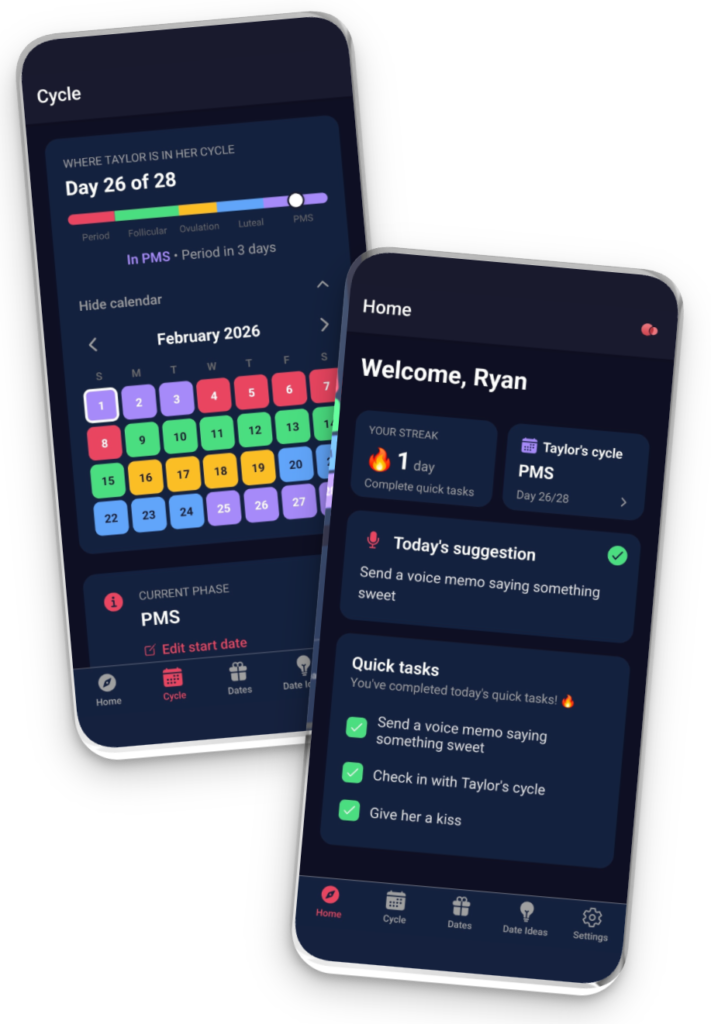
- Cycle tracking apps like DuoSync which is designed specifically for men in relationships
- Mental tracking if her cycle is consistent
The best way you can track your wife or girlfriend’s menstrual cycle is by using the DuoSync app, which was made for men for this exact reason.
You can download the DuoSync app down below:


Step 3: Look for Patterns
Every woman’s cycle is different, but they are… well… cyclical. Picking up on a pattern can be easier than you might think.
Pay attention to:
- When her energy dips
- When she’s more social
- When fights are more likely
While you can mentally note these things, it’s almost always better to actually track her cycle with an app or calendar.
Step 4: Adjust Your Behavior
This is where most guys mess up. They learn the theory but don’t apply it.
Don’t change who you are, but yes, small adjustments make a big difference:
- Give space when she needs it
- Offer help without being asked during tougher days
- Choose the right timing for important conversations
No grand gestures required. It’s really just the subtle shifts that make the biggest differences here.
What Cycle Tracking Is NOT
Tracking your partner’s cycle is not:
- A way to dismiss her emotions
- A tool to manipulate outcomes
- A substitute for communication
If anything, it should lead to more honest conversations, not fewer.
Common Mistakes Men Make
Assuming Every Mood Is “Hormonal”
This is the fastest way to lose trust.
Not every emotion is cycle-related. Treat her feelings as valid first, always.
Being Too Clinical About It
You’re not running an experiment. This is your partner.
Keep it human, and for goodness sake don’t rub her cycle phase in her face every chance you get.
Ignoring Individual Differences
Some women feel dramatic changes. Others barely notice any shift.
Adapt to the person.
If you find that your partner’s libido is actually higher during menstrual phase and wants to have mroe sex during that time, then take note of that! Not everyone’s cycle will look the same.
Why This Works
Hormones like estrogen and progesterone directly affect:
- Neurotransmitters such as serotonin
- Energy regulation
- Stress response
That’s why behavior and mood aren’t random. They actually follow real biological rhythms, which is why you can accurately predict mood based on cycle phase.
When you understand with those rhythms, your relationship will feel smoother.
Real-World Example
A couple keeps having the same argument every month. He feels blindsided. She feels misunderstood.
After tracking her cycle for two months, they notice:
- Arguments consistently happen 3–5 days before her period
- She feels overwhelmed and unsupported during that time
They make one change:
- No heavy discussions during that window unless necessary
The result:
- Fewer arguments
- Better communication
- Less emotional strain
Nothing dramatic. Just awareness and timing.
FAQ
Is it controlling to track your partner’s cycle?
Not if it’s done openly and respectfully. It becomes controlling only if used without consent or to manipulate behavior.
Make sure to get consent before tracking.
What if her cycle is irregular?
Focus on patterns rather than exact dates. Energy, mood, and symptoms still follow trends even with irregular cycles.
Should I tell her I’m tracking it?
Yes. Transparency will build trust with her. It should feel like teamwork.
Do all women experience strong cycle changes?
No. Some notice major shifts, others don’t. The value comes from understanding your specific partner.
Can this replace communication?
Yes and no. It can reduce fights, but it shouldn’t be a full replacement for important conversations. It should enhance communication but doesn’t replace it. You should still talk openly about how your wife or girlfriend is feeling.
What’s the easiest way to start?
Have a quick conversation, pick a simple tracking method (like using the DuoSync app), and pay attention for one month. That’s enough to see the patterns and reap the benefits.