
PMS is never an excuse for truly bad behavior, but it is a massive explanation for why someone might be struggling with their patience or emotional regulation.
You should think of it like being extremely sick or sleep deprived where your fuse is naturally shorter and your capacity to handle stress is lower. While it doesn’t give anyone a free pass to be abusive or cruel, it does mean that a person is operating under a significant physical and chemical load that makes “perfect” behavior much harder to maintain.
I have spent a lot of time thinking about this because I have seen it from both sides. There is this frustrating middle ground where we have to acknowledge that hormones are powerful while also holding onto the idea of personal agency.
If I am snappy because I have a pounding migraine and haven’t slept, I still owe my partner an apology if I am rude. The same logic applies to PMS. The feelings of irritability or sadness are very real and often uncontrollable, but how we choose to channel those feelings still matters.
It helps to look at the actual numbers to see how much this affects people. Roughly 75 percent of women report experiencing some form of PMS during their lifetime. For the vast majority, this looks like bloating, breast tenderness, and mild irritability. However, about 3 to 8 percent of women suffer from PMDD, which is a much more severe clinical condition. For those people, the “bad behavior” isn’t just being a bit moody. It can involve genuine clinical depression, intense rage, or panic attacks that feel impossible to “will” away.
If you are the partner in this situation, the best approach is usually to separate the person from the symptoms. When my girlfriend is in the thick of it, I try to remember that the person snapping at me isn’t the “real” her. She is just a version of herself that is currently being flooded with progesterone and estrogen shifts. It doesn’t mean I have to accept being a punching bag, but it does mean I can offer a lot more grace than I would on a normal Tuesday.
Here is how I usually handle the “behavior” aspect of it:
If she realizes she was out of line, she apologizes once she feels better. That is the accountability part.
I don’t take the bait when she is irritable. If I snap back, it just escalates a situation that is rooted in biology rather than a legitimate grievance.
We talk about it when she isn’t in the middle of her luteal phase. Trying to set boundaries while the hormones are peaking is a recipe for disaster.
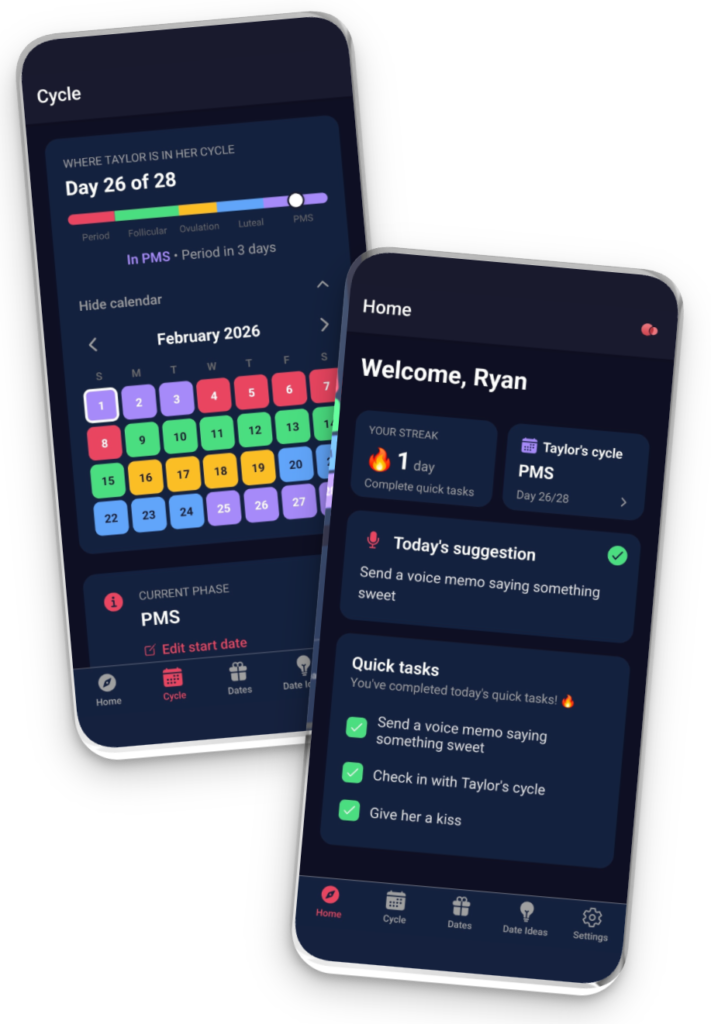
One thing that has actually changed the game for me is being proactive. It is way easier to be patient when you aren’t caught off guard. I started using an app called DuoSync which is basically a period tracker designed for men. It lets me see exactly where she is in her cycle so I can see the “storm” coming. If I know she is three days out from her period, I am much more likely to ignore a sharp comment and instead bring her a snack or a heating pad. It turns a potential fight into a moment where I can actually be helpful.


Download the DuoSync app to grow closer to your partner.
At the end of the day, a relationship requires two people trying their best. If one person is using PMS as a weapon to be consistently mean without ever apologizing or trying to manage it, that is a relationship problem. But if it is just a few days a month where things are a little tense and everyone is doing their best to get through it, that is just life.
FAQ about Managing PMS in Relationships
Can PMS cause permanent personality changes?
No, the symptoms are cyclical and tied to the luteal phase of the menstrual cycle. Once the period starts or ends, the emotional symptoms typically vanish. If the irritability is constant throughout the month, it is likely not PMS.
Is it okay to ask my partner if she is on her period?
Yeah but be careful. Even if you are right, it feels dismissive and like you are invalidating her feelings by blaming them on biology. It is better to just ask “How can I help you right now?” or “You seem stressed, what do you need?”
How can I track my partner’s cycle without being intrusive?
Using a shared tool or a specialized app like DuoSync is the best way. It allows you to stay informed about her cycle phases so you can adjust your expectations and level of support without having to ask her for a status update every day.
What is the difference between PMS and PMDD?
PMS involves mild to moderate physical and emotional symptoms. PMDD is a severe form of PMS that can cause significant disruption to work and relationships. If the behavior seems genuinely “out of control” or dangerous, it might be PMDD and requires a doctor’s visit.